
- Education
-
Research
Current research
Talent
-
Collaboration
Businesses
Government agencies and institutions
Alumni
-
About AU
Organisation
Job at AU
As the sea ice melts in the Arctic, new opportunities are opening up for the fishing and shipping industries as well as the extraction of oil and minerals. The major international interest in exploiting these new riches increases the need to cooperate.
2013.09.30 |
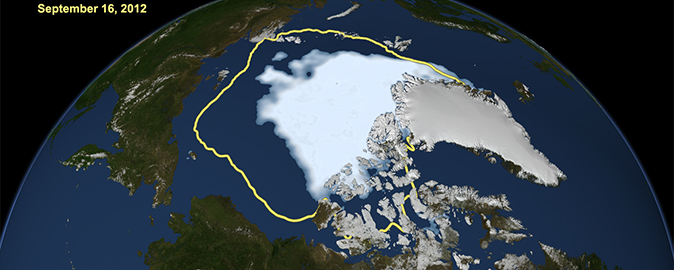
An image of the Arctic sea ice on September 16, 2012, the day that the Arctic sea ice reached its lowest extent ever recorded. The yellow outline shows the average sea ice minimum from 1979 through 2010. Source: NASA
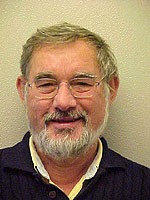
Emeritus Professor Nikolaj Petersen, Aarhus University
How are we to make sure that the increased economic activity in the Arctic is conducted in a responsible manner with no ensuing conflicts? For many years, emeritus professor of Political Science Nikolaj Petersen has been involved in studying the geopolitics in the Arctic, and according to him, the modern world south of the Arctic circle is quite literally knocking on the door of the Arctic. The melting of the polar ice caps in the Arctic seas will have economic benefits such as increased fishery productivity, boosting the shipping industry and not least the extraction of oil and minerals. But it will also have implications for the environment. Moreover, in this race to obtain the new riches there is also a danger of conflict, unless we collaborate to solve the new tasks that arise from the opening of the Arctic.
“First of all, as the ice melts, we gain access to new seaways - north of Canada and north of Russia - that shorten the sailing time from East Asia to Europe. Secondly, we have gained a much more thorough overview of the Arctic oil and gas deposits, and the melting also enables production in areas that were previously out of bounds in terms of development. Thirdly, as the ice caps melt, we are seeing increased access to mineral resources,” explains Nikolaj Petersen.
From Japan and China to Denmark and Greenland - everyone is lining up to secure a share of the Arctic riches. A particular problem is the distribution of the continental shelf in the Arctic Ocean between the countries that are adjacent to it.
"The primary players in Arctic politics are the eight countries that are members of the Arctic Council, including the ‘Arctic 5’ countries. These are the countries with territorial interest in the Arctic. Then follows a group of countries with observer status in the Council, such as China, Japan and South Korea, who share an interest in both the shipping routes as well as the oil and mineral resources,” says Nikolaj Petersen. Additional observers who take part in the Arctic Council’s work are representatives of the Arctic peoples as well as international organisations.
Currently much attention is given to the pending negotiations under UN auspices aimed at the distribution of the Arctic Ocean between the “Arctic 5” countries.
"Even though these countries have committed themselves to coordinating the division of the continental shelf in a peaceful manner, it is not unlikely that security policy conflicts will arise. And then we must ask ourselves whether we are approaching a conflict system or a system of cooperation?” asks Petersen and elaborates:
“For Denmark, the element of complication is that Greenland is a self-governing province. Denmark has given Greenland full authority of the management of resources, but there is a dispute about the ways in which Greenland is trying to force the pace of oil production and mineral extraction. Thus, there is tension within the Danish Realm. And this prompts the question: How many conflicts of interest will the Realm be able to endure?”
Another potential point of conflict lies in the countries’ overlapping claims to the continental shelf; for instance, both Denmark and Russia will be claiming the area around the North Pole.
On the other hand, if the countries do not cooperate, it will be hard to make proper use of the area’s resources.
“The Arctic is a vast area with a bad infrastructure. Many Arctic waters are shallow and have not been properly mapped out,” explains Petersen.
“All parties involved seem to have realised that it will be much harder to exploit the resources in the area, if they do not cooperate to reduce the uncertainties involved in the conflict. If the individual countries had to be in charge of arranging things themselves, it would be very costly,” he continues.
According to Nikolaj Petersen, collaborating on various security measures, such as search and rescue operations, ocean cartography, ice-breaking and ice and weather services, should be the natural approach. He therefore recommends international coordination in the form of agreements by which the countries divide the different tasks among themselves and establish agreement on how to approach the common challenges that are facing the world as a result of the opening of the Arctic.
Emeritus Professor Nikolaj Petersen, Aarhus University, School of Business and Social Sciences, Department of Political Science and Government,Tel. +45 8716 5248,nikolajp@ps.au.dknikolajp@ps.au.dk
au.dk/nikolajp@ps